“The album outlines the trio’s point of arrival, a mature work which I like to define as telepathic.The nine original compositions conceived in the form of a suite is the result of almost twenty years of writing, documented by three splendid recording sessions on disk, giving rise to the trilogy.Three distinct works that each expresses my soul, experimentation, experience and projection of thought,connected by a strong stylistic connection.” – Guido Santoni
New bass player Manuel Muzzu‘s album it’s been released and it’s available for digital purchase and for streaming. The album it’s a concentrate of much of music contamination starting fron jazz, fusion jazz, smooth jazz, latin jazz, where the bass guitar have a most important role playing rhythm part and also melodic part. Played with different techniques, with a different sounds colours.
Last One
“Last one” it’s a pretty simple listening track with a great smooth jazz influence and it’s the first song of my last album. The album it’s a concentrate of a different styles of jazz starting from smooth jazz, fusion jazz, Latin jazz, swing and classic jazz. Awesome played by spectaculars musicians, where the bass guitar in all his shapes (4-5-6 strings fretted and fretless) have the dominant part .
Marco Pacassoni Trio feat. John Patitucci & Antonio Sanchez (Italy): Album: Life Label: Egea Music Giotto Music
Time Vibes
Marco Pacassoni: vibraphone, marimba John Patitucci: electric and acoustic bass Antonio Sanchez: drums
Life is a dream told in music. I couldn’t have given it a different title. It is the dream of a life lived intensely every day. Like that of every individual, but in particular that of every musician. A life that never as today must necessarily include diversity to be fully lived. I don’t think an uncontaminated artist has any sense now, if not nostalgic, because as someone said “we are not islands” but the need to merge and not separate in the name of who knows what has ever happened in the past, still remains the goal to reach.
I was born in Fano, a small town famous for its Carnival and for being “The City of Fortune”. In my case, luck in luck was that Fano has hosted an important Jazz Festival for almost thirty years and I had the opportunity to listen to the best musicians in the world in my home from an early age. I have probably also listened to historical concerts that I don’t remember anything about, but what is certain is that that music made everyone breathe a different air, even if at first only for a few days a year. It was almost inevitable that I went to their house as soon as possible to learn and understand.
At Berklee College of Music in Boston I understood what it means to confront and learn from others. It is there that my microcosm broke up to make room for a horizon made up of multiculturalism and inevitable contamination. It goes without saying that in such a school, you enter thinking you are good and if you are lucky, and if you are really good, you come out with something less in terms of self- esteem. Such a badly lived place could also definitively undermine anyone’s aspirations and career because there are more good people in the world than you can imagine. Or perhaps because there is inevitably a greater concentration there …
It is a place where provincialism becomes folklore that can implode and destroy you or explode into a universe of different sounds, tastes, smells, shapes, cultures that gradually become more and more familiar. Contrasting events and emotions transformed into notes that I sang with the voice of my instruments.
And after what has been said so far, I can’t even say what kind of music it is. The initial rhythm is complex, but it’s best to stop counting and let this stream of notes try to excite you. Because in this piece there are no virtuosity and there is no comparison, but only dialogue. They are more or less complex lines that intertwine, almost in a whisper and at times it seems to me, listening to John’s solo, that the notes really become words.
Transmitting the sensations of a dream is difficult, but it becomes possible if you tell your dreams to two great musicians and to two beautiful people like John Patitucci and Antonio Sanchez, whom I will never stop thanking for all this. But this is only the “title track” and so … the best is yet to come. Thank you so much.
Giorgio Panico(Italy)-Album: I Ching (Dodicilune Records, 2022)
This album is based on the homonymous ancient Chinese divination text. The tracks were composed by elaborating the underlying philosophical and mathematical concepts. The musical choices were confirmed by consulting the oracle itself.
“The method of the I Ching does indeed take into account the hidden individual quality in things and men, and in one’s own unconscious self as well.” (C. G. Jung – Zurich, 1949)
Tracks 1. Ch’ien the creative, heaven 2. Sun the gentle, wind, wood 3. K’an the abysmal, water 4. Li the clinging, fire 5. Tui the joyous, lake 6. The effect of signs on building character 7. K’un the receptive, earth 8. The inner world arrangement 9. The primal arrangement 10. Chên the arousing, thunder 11. Kên keeping still, mountain 12. Cultural history
Musicians Giorgio Panico: bass, pipa Carlo Cantini: violin Luca Maria Burocchi: guitar, banjo Emanuele Pellegrini: drums, percussions Music by Giorgio Panico
Produced by Giorgio Panico and Maurizio Bizzochetti, Gabriele Rampino, Dodicilune Label manager Maurizio Bizzochetti (www.dodicilune.it)
Recorded March, May 2021 at Studio Teclas, Perugia, Italy Sound engineers Luca Maria Burocchi, Daniele Marinelli Mixed and mastered September 2021, January 2022 at Studio Teclas, Perugia, Italy Sound engineer Luca Maria Burocchi Cover artwork by Anna Gebbia Photos by Anna Gebbia, Leonardo Corgna
Giulio Scaramella – Piano Marco Trabucco – Doublebass / Compositions Luca Colussi – Drums Maddalena Calamai – Flute Costanza Pennucci – Horn Emanuele Andreatta – Violin Alessandro Dalla Libera – Viola Federico Motta – Cello
CREDITS Mixed and mastered by Stefano Amerio at Artesuono Studio, Cavalicco (UD), produced by Marco Trabucco for Abeat records.
X [ics] is the new album by doublebass player Marco Trabucco.
Innovator in his area, Marco Trabucco embraces experimenting with contemporary music’s new sounds. His latest album, “X [ics]”, is a demonstration of his commitment to pushing the boundaries of contemporary jazz and breaking away from the homogeneity that has become prevalent in recent years.
The title of the album, which references the ten performers featured on the album as well as the unique blend of classical chamber music and jazz, serves as a fitting representation of Trabucco’s willingness to challenge conventions and explore the unknown. The new album is a must-listen for aficionados of forward-thinking jazz, as it showcases Trabucco’s ability to seamlessly integrate disparate styles, and his openness to new musical stimuli.
Indeed, the structure of the band combines a classical ensemble (flute, horn, piano and strings, joined by marimba and balafon) with the typical jazz quartet. The album showcases several nods to jazz greats, such as Chick Corea’s “Temple of Isfahan” on the opening track “One for Max”, and the beginning of the theme of Coltrane’s “Giant Steps” which is reworked as an evocative variation on the last track “Otranto”.
Think, for example, of Schoenberg’s chamber music for strings, where intervallic tensions from the classical music are sometimes used to achieve the desired timbral and harmonic results. As far as orchestration choices are concerned, the solutions adopted propose sound refractions aimed at broadening the harmonic spectrum of the thematic cells used. From the perspective of a jazz musician like Trabucco, there is a seamless succession of traditional elements, sounds from the classical zone, and areas of improvisational themes that combine into a potential infinite.
David Linx, Guillaume de Chassy, Matteo Pastorino Nouvel album On Shoulders We Stand Disponible chez Enja/Yellowbird Records
David Linx, Guillaume de Chassy and Matteo Pastorino ont sorti en trio l’album On Shoulders We Stand chez Enja/Yellowbird Records.
Sur cet album, le pianiste Guillaume de Chassy, le chanteur David Linx et le clarinettiste Matteo Pastorino s’inspirent d’oeuvres de Bach, Chopin, Rachmaninov, et Ravel. David Linx leur a écrit des paroles, Guillaume de Chassy s’est occupé des adaptations, pour cette osmose entre jazz et musique classique.
Après Drown Out The Noise, un titre adapté de Sergueï Rachmaninov, David Linx, Guillaume de Chassy et Matteo Pastorino nous offrent Souls Astray, un titre inspiré par la Sonate pour piano D.537 de Schubert. “Souls Astray est une composition de Franz Schubert qui a déclenché tout notre projet d’album. Quand nous avons entendu la transcription de Guillaume de Chassy, nous avons tout de suite senti que les parties instrumentales pourraient devenir un nouveau répertoire pour le chant, autant jazz et classique. Ce projet a été une libération artistique puisqu’il fallait construire depuis un nouvel endroit et les mélodies me dictaient les textes en quelques sorte. Souls Astray est une ode à la compassion et la beauté de la patience en amour et amitié” a expliqué David Linx.
David Linx au chant, Guillaume de Chassy au piano et Matteo Pastorino aux clarinettes nous offrent l’album On Shoulders We Stand, un disque en trio, inspiré des musiques de Bach, Ravel, Scriabine, Schubert, Chopin, Mompou, Rachmaninov et Chostakovitch. Les textes sont signés David Linx et les transcriptions assurées par Guillaume de Chassy.”Nous n’inventons rien totalement ; nous nous tenons sur les épaules des grands créateurs qui nous ont précédés ou de ceux que nous côtoyons aujourd’hui : musiciens, peintres, écrivains … ces géants nous soutiennent et nous inspirent chaque jour.” C’est ainsi que David Linx et Guillaume de Chassy, initiateurs de ce projet, définissent leur démarche commune. Avec On Shoulders We Stand, les trois musiciens se sont lancés un défi de taille, assumant joyeusement une prise de risque devenue rare dans le conformisme ambiant.
David Linx on vocals, Guillaume de Chassy on piano and Matteo Pastorino on clarinets released the album On Shoulders We Stand, a trio album inspired by the music of Bach, Ravel, Scriabin, Schubert, Chopin, Mompou, Rachmaninov and Shostakovich. The texts are written by David Linx and the transcriptions by Guillaume de Chassy. “We don’t invent anything totally; we stand on the shoulders of the great creators who have preceded us or those we rub shoulders with today: musicians, painters, writers … these giants support us and inspire us every day.” This is how David Linx and Guillaume de Chassy, initiators of this project, define their common approach. With On Shoulders We Stand, the three musicians have taken on a major challenge, joyfully assuming a risk-taking that has become rare in the current conformism.
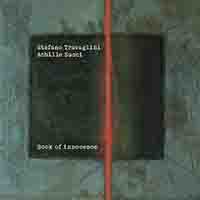
“With their new recording, Book of Innocence, Stefano Travaglini and Achille Succi have released an inspired recording and it is something quite beyond convention. Stefano came to my attention in 2017 with his extraordinarily wide-ranging solo album Ellipse (Notami Jazz, 2017), his first leader recording. Another outstanding solo outing came in 2020 with Monk – Fifteen Piano Reflections (Notami Jazz). A multi-instrumentalist and composer, Stefano’s primary focus, on his recordings, is the piano. He won first prize at the International Piano Competition for Composers “G. Canciani” and Book of Innocence is Stefano’s fifth album as a leader or co-leader. As on two of his previous releases, The Hungarian Songbook (Terre Sommerse, 2013), and The Long Line (Odradek Records, 2019), Book of Innocence is a duo recording with fellow Italian, Achille Succi. He is a multiple award-winning musician, principally self-taught, on alto, and bass clarinet. Achille has performed with Louis Sclavis, Ab Baars and Ernst Rejiseger, among others.
Stefano Travaglini & Achille Succi- Bauci
Piano/clarinet duos are rare but the Travaglini-Succi duo presents a captivating interchange, based on visual arts, literature, and a myriad of further stimuli. The album opens with “Rothko”, inspired by the Russian-born abstract expressionist Mark Rothko. The artist has been celebrated in music before; most notably with Morton Feldman’s chamber work, “Rothko Chapel” and the dark alternative rock of Peter Gabriel in “Fourteen Black Paintings”. In its context, the Book of Innocence tribute is truer to Rothko’s artistic vision with its surreal churning of direction and timbre.
“Bauci” takes its inspiration from the novel “Invisible Cities” by Italo Calvino. The musical piece more than does justice to the fanciful tale that ponders on notions of recollection and place. Achille, here on bass clarinet, plays a beautiful, unassuming melody over the intricate harmony of the piano. “Silent Moon” and “Turning Tables” each exude a nocturnal serenity without limiting the possibilities of their individual instruments as Stefano and Achille switch places at the forefront. In these pieces, the duo excels in a creative interaction that is both fragile and impervious.
Pat Metheny’s “Travels” is the single cover on an album of Travaglini compositions and improvisations. The duo gives us an inspiring and imaginative take on the guitarist’s 1983 original, retaining Metheny’s evocative feeling while immersing themselves in their heartfelt version of the piece. On “Blues for Days to Come”, the lead is given over to Achille while Stefano supplies circular rhythm. As the piece progresses, Achille’s playing opens up and his excellent improvising puts the “blues” in a more modern context.
Book of Innocence closes with the extended title track, bringing the album to a thematic full circle. “Book of Innocence” has something of a spiritual connection to Henri Matisse’s The Red Studio. That 1911 creation by the French artist was less than universally embraced initially, but went on to influence other great artists including Rothko. It is a survey of some of the artist’s work consisting of paintings sculptures, and ceramics, within a single painting. With great resourcefulness, Stefano and Achille incorporate six of the pianist’s shorter compositions into a single unified grouping. The transition is almost seamless and the music is, by turns, poignant, cerebral, or reflective.
It is no surprise that Book of Innocence finds inspiration, in part, from the works of masters of the visual arts. Stefano and Achille paint vivid pictures with their music establishing a meeting ground for diverse artistic expressions. The duo plunges themselves into the full extent of their imaginations; their playing is neither predictable nor pretentious and not a note is wasted.
The Museum of Modern Art describes the centerpiece of Matisse’s The Red Studio as a grandfather clock with no hands. They suggest that the visual work exists in an environment where time is put on hold. It can be said that this exceptional work of art, Book of Innocence, lies in a similar place. These two virtuoso musicians have given us a collection that warrants repeated and complete attention. It is an exceptionally rewarding listening experience.”
Karl Ackermann All About Jazz.
Recorded, mixed and mastered at Studio Sequenza (Paris) sound engineer, Thomas Vingtrinier
Italian pianist Roberto Magris has developed his career in synergy with the best of American jazz, the proof is his work of great diversity and inventiveness where experimentation has always played an important role. His collaborations with American jazz personalities have proved to be not only inspiring but also a basis for a creative dialogue that has made its mark on all the albums he has released, his latest album is one of them.
Roberto Magris Duo & Trio brings to the fore the collaboration with late saxophonist Mark Colby present on six of the album’s eleven tracks. It is worth mentioning that the two musicians played together on “Sun Stone” released in 2019.
The other songs are performed by Magris accompanied by a trio with whom the pianist has collaborated many times in the past: Elisa Pruett, bass, acoustic, Brian Steever, drums, Pablo Sanhueza, congas.
Right from the first composition, the mastery of the two performers is evident and the balance of forces is remarkable. We listen to two musicians at the height of their creative powers combining their personalities with a naturalness of great finesse.
The trio gives us superb versions of familiar standards, each filtered through the creative mastery of the pianist. The album contains four originals in which Magris’s compositional mastery is complimented by Colby’s clear, soulful phrasing.
Considering that Colby passed away two years ago, this album is a historic recording, and here we have to thank both Roberto Magris and his friend Paul Colins at JMood records for giving us the opportunity to listen to such a collection of jazz gems.
After his solo experience in ‘Wood Tales’ (published on Feb. 2021) Jacopo Ferrazzacomes back as a band leader, guiding a quintet with two very special guests,Fabrizio Bosso(trumpet) andMarcello Allulli (sax).
A dreamlike world emerges from Ferrazza’s compositions and is outlined by the right balance between modern jazz, chamber music and electronic music.
Jacopo Ferrazza Quintet – Fantasia
The nine tracks of ‘Fantàsia’ follow a narrative that resembles a sequence of disjoined dreams appearing in an unorderly fashion nonetheless composing a greater holistic story. As the music unfolds, introspective lyrics written by Ferrazza himself describe the thoughts of a WWII soldier, briefly before his death during the Normandy landings (La Course), as well as Siddharta’s concept of the cyclicality of time (River Theatre) and again the surreal tail of a time-travel vortex (Blue Glow). Interstellar voyages, synesthetic worlds and the theme of afterlife are also part of ‘Fantàsia’, the latter being a topic very dear to Jacopo Ferrazza, especially after his record ‘Rebirth’ (Cam Jazz 2017).
Starting from his approach to the acoustic sound of the double bass, the Italian musician develops an accurate overall aesthetic to his compositions through electronics and pianist Enrico Zanisi contributes greatly to this intent thanks to his extensive use of synths, becoming a fundamental element to creating a precise setting in each track. The album becomes an intentional screenplay where each element has its specific role, for example Valerio Vantaggio’s drums hold the music’s emotional pulse. Alessandra Diodati, here in her first recording experience, guides listeners through the different layers of the chronicle with her voice. And again Livia de Romanis’ cello represents the fire, a primordial force we find behind the most vivid nocturnal visions. The trumpet played Fabrizio Bosso incarnates an irruptive element which deconstructs all the rules of a well designed world, and last but not least, the Shorter-like tone of Marcello Allulli’s sax has a cathartic and celebrative role in the ending of the record.
The element that leads the musical narrative is Jacopo Ferrazza’s double bass, that always joins his music partners enhancing each role, underlining the different personality of the band’s members and pulling the whole architecture’s strings together.
‘Fantàsia’ is an album that witnesses the vital creativity of Ferrazza, which manifests itself also in his attitude to explore, especially those little shadows of our daily life, where we can find, if we look closely, a magical world waiting to be experienced.
Roberto Magris(Italy)-Match Point Composer: Roberto Magris Album: Roberto Magris-Match Point Label: JMood Records On Match Point, his latest album, Italian pianist and composer Roberto Magris gathered together a brilliant line-up of accomplished musicians: Alfredo Chacon – Vibraphone And Percussion, Dion Kerr – Bass, Rodolfo Zuniga – Drums on what can be described as a festival of rhythms and styles from bebop, to blues, and Latin. His signature style and imaginative arrangements put a new spin on compositions by Richard Kermode, McCoy Tyner, Thelonious Monk and Randy Weston along with four originals that blend into the mix like a charm. One of the special beauties of the album lies in the delicate balance and fusion between piano and vibraphone radiating a warm melodic atmosphere filled with generous spaces to improvise. Plenty of surprises, the album takes off with Yours is The Light, made famous by Santana on his Welcome album. Of course, there’s no guitar here, nevertheless, Roberto Magris takes it to new jazz heights while maintaining its Latin edge and beauty. It is a pity that Kermode died young; he would have been so proud to hear his composition wearing these new clothes. Searching for Peace is a 15-minute long rendition of McCoy Tyner’s ballad, an opportunity for subtle improvising and rhythm changes. The sunny Samba for Jade is another showcase of the virtuosic piano-vibes pair based on a memorable melodic theme signed by Magris. Magic Blues, is exactly what the title promises: blues made magic by a combination of extended solos of vibes and piano. On Thelonious Monk’s Reflections, the pianist takes the liberty to surprise us with an imaginative version that maintains a beautiful fluidity through the fast-changing harmonies. Caban Bamboo Highlife retains the festive mood and alert rhythms of the original piece, bringing forward the outstanding art of Rodolfo Zuniga. Without the horn section blowing on the original, the sound is smoother and graceful yet not losing its playfulness. Match Point the title track, another original, goes vibrant and swinging, the band is going over the top in a frenetic ride. To use just one keyword to describe this album: splendid! Roberto Magris @ JMood Records
From Saturday July 10th 2021, “The rising sun”, the new and fourth album by modern jazz guitarist Fabrizio Savino, is available on all streaming and download platforms including Apple Music.
The album is also physically distributed worldwide by Inner Urge Records through the website innerurgemusic.com, in Benelux by Xango Music and will soon be available also in Japan, Taiwan and Hong Kong through the Albore Jazz distributor.
Two weeks after its release, the album has over 80,000 plays only on the Spotify platform and has been selected by the editors and included in important playlists such as “State of Jazz”, “Jazz X- Press” and “All new Jazz”. The song “Rebirth” was selected and played, accompanied by a beautiful introduction to the album for the Anglo-Saxon audience, by presenter Chris Philips of the London radio station Jazz FM UK.
After the success of his previous production “Gemini” that has won many awards and was broadcasted by the most important worldwide radios (France, Norway, Germany, Italy, Greece, Spain, Finland, USA, Canada and Japan), Savino brings rock sounds through a deep contemporary jazz language. With “The rising sun” Savino explores many sonorities and composes music starting from an inner analysis. The main topic of the album is the “Rebirth”.
The musical journey it’s the transposition of inner energies through the music language and the spiritual research with the practice of meditation and yoga. The songs of the album were composed over a period of one year and embrace many of the musical forms that have always fascinated the author who was able to translate them into the line-up that best represents him: the Guitar trio. The modern jazz sound that distinguishes him is intertwined with the sounds that most influenced his adolescence, the rock of Frank Zappa and Jimi Hendrix. “The Rising Sun” is a musical journey that mix of eleven tracks, two standards and nine original compositions one of which includes an arrangement for string quartet.
To complete the line-up there are the Italian double bass player Luca Alemanno and the German drummer Sebastian Merk, musicians with whom Savino has a particular musical, artistic and human affinity.
For the release of the album, the official videoclip was published on Youtube and on the Facebook and Instagram pages of the label and the artist.
It will soon be published a video animation, entirely hand made with the technique of ink on paper by the graphic designer Marika Mastrandrea of the MM Visual Communication Design Studio, for the song of the album with the string quartet “So close and yet so far “.
Earlier this year, Music For Love released a charity project entitled Music For Love Vol. 1. The opening track “Cantabile 2.0” by Fabrizio Bosso and Pablo Nannucci, aka Roc Flowers is inspired by the great jazz pianist Michel Petrucciani “Cantabile.” "Cantabile 2.0" adapted modern hip-hop texture on top of existing melody ideas, drawing influences from jazz standards and funk. Soon after its release, the tune received support from Michel Petrucciani’s family. Alexandre Petrucciani, the younger son of the jazz master, was impressed by Pablo Nannucci, aka Roc Flowers’s hip-hop fusion, “I’m very happy that people still care about his music enough to make stuff around it. It’s really good.”
“Cantabile 2.0” presents a series of butterfly effects from one creative mind to another, stretching into time and space. The song preserves moments of inspiration that continue the conversation between past and future. “This is really a big thing for a young guy like him for his first approach,” the founder and director of Music For Love also expressed high hope for the young artist.
The Petrucciani brothers have been more visible in supporting jazz artists and promoting their father’s music in the past five years. The brothers work as a team, aiming to influence more people. “It’s a link between now and the future, towards new people knowing his music later in life or in time,” said Alexandre.
Michel Petrucciani was exceptional. He was gifted as a musician but special as a person. “A little spark that makes a person shine brighter,” Alexandre described, “he was the person who glues everyone else around him.” Few people knew that the legendary jazz pianist who traveled by plane most days of the year was afraid of heights. Losing Michel Petrucciani was a shock to the family. For them, the loss never heals. “There’s not one day I don’t think about him,” said Alexandre, “It leaves no doubt how much I love my father. He was touring three hundred days a year, but when he was around, he was here 100 percent. He was genuinely happy.”
Memory tends to fade as time passes by, but the love people have for Michel Petrucciani keeps his memory alive. Alexandre expressed his appreciation to tribute concerts and music made in honor of his father, “it’s memory and an honor to be a son of my father,” he said. He has been supporting artists through social media engagement and attending tribute concerts, encouraging young jazz musicians to follow their passion.
Alexandre also inherited his father’s touch with the piano. Although he has never touched a piano until recently, he revealed having a special connection with the instrument. “It’s like I can feel the piano,” he said, “It makes no sense.” He admitted not studying piano with his father was one of his biggest regrets. The early recordings hold a special place in his heart. “I like the Best of the Blue Note Years. That’s my favorite,” said Alexandre, “he (Michel Petrucciani) was younger and had a different energy.”
Roberto Magris(Italy) & Eric Hochberg(USA)-Shuffling Ivories
Album: Shuffling Ivories
Label: JMood Records
A heartfelt, intimate tribute paid by two seasoned musicians, pianist Roberto Magris and bassist Eric Hochberg to African American jazz musicians and especially to Eubie Blake, a jazz pioneer whose contribution to the American jazz and culture is undeniable. Roberto Magris has never shied away from sharing his personal vision and talent as a composer and performer when paying homage to the past, and this album is no exception. The flawless interplay between the two musicians is a definite asset to this enchanting album, which creatively mixes tradition and contemporary without losing the original spirit of these timeless classics. Besides two compositions signed by Blake, the album includes pieces by Trudy Pitts, Andrew Hill, Jack Palmer and Spencer Williams, Billy Gault, Cal Massey and by Roberto Magris himself. His composition “Shuffling Ivories” sets the tone referencing Blake’s Broadway musical “Shuffle Along”. He also signs two other works that are wonderfully related to the theme. On “Italy,” he creates a melodic connection between European and American jazz, while “Clef Club Club,” an intense display of impressive virtuosity with a cinematic edge, is an eruption of impressive virtuosity. The elegant and romantic Andrew Hill’s La Verne, one of the album’s most stunning pieces, transforms into a ballad of unique beauty that defies classification; it’s pure music, and both musicians excel at performing it.
Stefano Di Battista revient sur le devant de la scène, avec cette fois-ci un projet dédié au compositeur émérite Ennio Morricone. L'ambition est donc de taille pour ce nouvel album Morricone Stories qui sort le 02 avril 2021 chez Warner Music.
C'est en quartet auprès des musiciens André Ceccarelli (batterie), Frédéric Nardin (piano) et Daniele Sorrentino (contrebasse) que le saxophoniste s'illustre une nouvelle fois afin de rendre hommage à l'un des plus grands noms de la musique de film.
Altiste fougueux que n’effraient pas les tempos intrépides, ou bien lyrique total, Stefano Di Battista cultive au fil de sa carrière une virtuosité sur le saxophone et une présence sur scène qui en ont fait l’un des musiciens les plus remarqués en France, des amateurs comme du grand public.
La capacité de Stefano Di Battista à établir un dialogue avec d’autres artistes était une évidence sur ses derniers albums, parmi lesquelsGiù la Testa (2014), enregistré avec le guitariste Sylvain Luc. Le saxophoniste confirme son immense talent en s'attaquant aux thèmes les plus célèbres comme ceux des films de Sergio Leone, mais aussi plus méconnus (Veruschka, La cosa buffa...) du célèbre compositeur Ennio Morricone.
La musique d’Ennio Morricone pour le cinéma est une source créative infinie associée à une grande variété d’images. La plonger dans le jazz l’élève à un niveau inédit en créant une association parfaite, un partenariat naturel et presque inévitable. Et notamment lorsque ce dernier est entre les mains de quelqu’un comme Stefano Di Battista.
Le saxophoniste s’empare des thèmes du compositeur et les réinterprète, accompagné d'un groupe de choc : André Ceccarelli (batterie), Frédéric Nardin (piano) et Daniele Sorrentino (contrebasse).
Stefano Di Battista ne s’est pas cantonné aux plus célèbres bandes originales de Morricone, celles qui sont gravées dans l’inconscient collectif. Dans certains cas, Stefano a choisi des thèmes moins connus, ou plutôt des airs de films moins célébrés ou oubliés comme Veruschka ou Mais… Qu’avez-vous fait à Solange ?, à la fois pour se plonger encore plus profondément dans un répertoire encore peu exploré, mais aussi pour rappeler que Morricone a signé les bandes-son de plus de 500 films, dont seuls une poignée sont encore adulés aujourd’hui.
Ces mélodies sont à la fois raffinées et très précieuses, et vous aurez l’occasion de redécouvrir des thèmes que vous connaissez par cœur sous la forme de parfaits standards jazz, à l’image du swinguant et malin Metti, una sera a cena, ou encore Le Bon, la brute et le truand réinventé en duel d’improvisation, avec le saxophone reprenant la brève salve de notes inspirées par le cri du coyote, avant de se dissoudre dans l’émotion pure du “Deborah’s Theme” d’Il était une fois en Amérique.
On trouve également une relecture inspirée de The Mission, dans laquelle le hautbois de la version originale est transposé sans effort pour un saxophone soprano, et Flora, une composition inédite que le révéré Maestro a offert à Di Battista. Au final, la mécanique est sans faille et pourrait engendrer une série d’enregistrements, comme si une partie de l’esprit de Morricone avait toujours été – peut-être inconsciemment – tournée vers le jazz. L’’album “Morricone Stories” paraîtra le 02 avril 2021 chez Warner Music.