Chris Kase flugelhorn & cornet · Toni Belenguer trombone · Mikel Andueza alto sax
Abe Rábade acoustic piano & Rhodes · Masa Kamaguchi acoustic bass · Iago Fernández drums
Recorded at Boom Studios, Vila Nova Da Gaia (Portugal) by João Bessa 9-10 May, 2011 http://www.chriskase.com
Bruce Barth, despite his professorship at Temple University, is no stodgy jazz egghead. He is a working musician with an abundance of technique, a seemingly bottomless well of ideas and is a composer of considerable skill with a contemporary and inventive approach, with many of the works here being Barth originals. Barth's solos are witty and insightful while his innate harmonic sense makes him a perfect accompanist when backing solos by others. Joining the front line is the masterful vibes player Steve Nelson, who always swings hard, but also manages to play with a soulful lyricism.
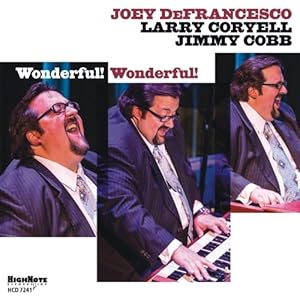
Joey DeFrancesco has come a long way from All of Me, his recording debut as a leader made in 1989 as a fresh-faced 17-year-old. From the get-go, Joey established his credentials with virtuoso technique and an innate soulfulness. Throughout his early career, he was recognized as spearheading a renewed interested in the B-3 organ, and building a bridge from the instrument's golden period of the 1960s to the modern usage that it enjoys today. With jazz guitar great Larry Coryell & legendary drummer Jimmy Cobb, Joey imbues the venerable genre with new life, vigor & a modern sensibility. amazon.com
JMood Records and Italian pianist Roberto Magris joined forces to bring out from obscurity a set of compositions belonging to influential be bopers of 40's and 50's. The name and the graphics of the album are a reverence to Elmo Hope, a talented pianist and composer who died at only 44 in 1967, unfortunately less known than Bud Powell and Thelonious Monk.
Joined by Elisa Pruett on bass and the legendary Albert "Tootie" Heath on drums, the experimented Roberto Magris delivers a solid performance in perfect harmony with the work of his predecessors. However the attractiveness of this album does not rely only on its historical value, but mainly on the high artistic quality of all the renditions and imaginative solos that compose the selection.
Enlivening tunes from the treasure chest of the be bop era requires a serious command of the technique and a convergence with the spirit of the repertoire. Roberto Magris is the man of the situation, he has already proved these qualities on many recordings during his successful career. As always he is bringing his own musicality and imagination on board, leaving his mark on each vtune starting with Elmo Hope's "Happy Hour" that opens the set in a joyous mood fueled by the conjoined energies of piano and rhythm section.
Tad Dameron's atmospheric "If You could see me now" reveals the artistry of a subtle improviser backed by a superb rhythm section floating and twisting around the melody. The warm atmosphere goes on with the "Theme From The Pawnbroker", played with a lyrical clarity while preserving the cinematic quality of the original theme. On the unforgettable "I Didn't Know About You" the art of the piano mingles together with the art of bass and drums to reveal unexplored beauties of Ellington's standard.
The show goes on with the entertaining incisive swing on "Elmo's delight" the only original of the album, and continues with Herb Geller's "Half May" a piece with a beautiful melodic-romantic contemporary edge well suited for a movie soundtrack.
"Tootie" Heath opens in force "East 9th Street", an extensive showcase of the volcanic power of the trio. Bass and drumming come forward in an explosion of high energy with the piano pushing the improvisation to new heights, followed by a return to a seductive melodic-experimental line.
The ballad "My Heart Stood Still" comes as far as 1927 and was recorded by musicians all over the world, here played by Magris in a captivating rather unconventional joyous mode. Fire Waltz becomes an inventive "Free Waltz' full of abundant adventurous bursts ending the album on a high creative note.
Useful and interesting, along with the music the CD includes a brief presentation of the concept by impresario Paul Collins, founder of JMood Records. An exciting first volume of "One Night With Hope...and More" that will be enjoyed by straight ahead fans and not only.
Chris Cortez turns in an eclectic batch of 3 vocal and 9 instrumental tunes. Classics, re-imagined as Latin jazz groove machines, Steely Dan-ish, funkyness, moody re-harmonized Disney themes, clever lyrics, spiritual wisdom, sophisticated, yet accessible arrangements, amazing musicianship, stellar sound… in short, this is Chris’ masterpiece. Decked out with Mark Piszczek’s lush horn arrangements and a fantastic band. Featuring: Glen Ackerman, Guillermo Reza, James Metcalfe, Woody Witt, Andrew Lienhard, Joel Fulgham, Carol Morgan, Warren Sneed, Will Cruz, Texas Johnny Boy, Bernard Pierre, and Thomas Hulten. CHRIS CORTEZ / "AUNT NASTY" “I find the music of Chris Cortez to be an important message to listen to. Some great moments, that shouldn’t be missed. Chris, .......... Bravo!” Pat Martino http://www.bluebamboomusic.com
"Lets get right down to it: Reunion: Live in New York, the new album on Pi Recordings, from Sam Rivers, Dave Holland and drummer Barry Altschul is an album that you absolutely need to check out." - Outside-Inside-Out
"At a Columbia University concert, the three free-form masters picked up where they left off after a 25-year hiatus." - Ottawa Citizen
Pi Recordings is very proud to announce our next release; the culmination of three years of work. A historically important new release,The Sam Rivers Trio's Reunion: Live in New York captures saxophonist/flutist/pianist Sam Rivers with his groundbreaking trio ofDave Hollandon bass andBarry Altschul on drums recorded live in front of a packed Miller Theatre at Columbia University in 2007. The trio was influential for helping lead the movement towards “free form” playing on the “loft jazz” scene in the 1970s. Over two sets, their powerful rapport in these fully-improvised performances gives no clue that they had not played together in 25 years when this concert took place.
Reunion: Live in New York wont be in stores till September 25th, but is available now exclusively through Pi Recordings. The release coincides with what would have been Sam Rivers’ 89th birthday; he passed away on December 26, 2011. A leading figure in jazz, Rivers led a remarkable assortment of aggregations, from the small groups on his four classic albums on Blue Note in the 1960s to duos to big bands over the following decades. He also played in the bands of such luminaries as Miles Davis, Andrew Hill, Cecil Taylor and Dizzy Gillespie and his composition Beatrice is a standard in the jazz repertory. His big band albums Inspiration and Culmination from 1998 were both nominated for the Grammys.
It would be hard, though, to overstate another important role that Rivers played in jazz: He was the founder and proprietor of Studio Rivbea, the most prominent of the many jazz “lofts” that sprung up in downtown Manhattan in the 1970s that encouraged a more open approach to the music. Rivbea began hosting concerts, workshops, and rehearsals in 1972, just as Rivers-Holland-Altschul began playing together intensively. Other bassists and drummers played with Rivers, but they were the preferred formation from the fall of 1972 when Holland joined the group until the summer of 1978 when Altschul left to pursue his own projects as a bandleader.
The trio also became the main vehicle for what Rivers often called his “main contribution” to the music: the exploration of “free-form” playing. In a 2002 interview, he explained that by “free” he did not mean avant-garde or atonal, but instead that there was “no preconceived idea, no preconceived melodies or harmonic attitude.” Rivers sometimes went so far as to claim to have originated this approach. As Holland puts it, “each night we started with a blank page.” According to Altschul, they developed what became an almost extrasensory attunement to each other through extended jam sessions: “We got together let’s say at eleven o’clock in the morning and we just played until five o’clock in the afternoon. If we had to go to the bathroom, then it was a duo. If we had to eat, there was maybe a solo. But the music continued from eleven to five.” The aim was not only to become familiar with each other, but also to find and play through the “dead spaces” in the music, to concoct tactics for avoiding them in performance. “After a while,” Rivers noted, “you’ve run through all your clichés.” The group became known for its marathon concerts, with Rivers circulating among tenor and soprano saxophones, flute and piano, giving each performance the feeling of a suite with shifting dynamics among the players.
What separates this trio from some of the more incendiary exemplars of 1960s “free jazz” is the sense that nothing is out of bounds: there are moments of thorny dissonance, but also currents of limpid melody, and moments where a tonal center shimmers into view or the music locks into a groove. As Altschul points out, “freedom” means above all “freedom of choice” among any number of stylistic parameters at any moment in performance. In the late 1990s, Holland remarked that he was struck by the way Rivers “uses all his musical experience when he plays,” from the blues to bebop to the more harmonically venturous elements of his own music and he never forgot something Rivers said to him: “Don’t leave anything out: play all of it.” Rivers called the 1970s a “culmination” of the previous decades, and the trio in this sense was an enactment of the somewhat idealistic but thrilling notion that improvisers working at the height of their powers can draw on “a total access to all musical elements.”
The special reunion concert was the culmination of Columbia University radio station WKCR’s week-long Sam Rivers Festival, which was breathtaking in its sustained focus, as in-depth interviews with Rivers and many of his key collaborators were interspersed within a chronological review of his legacy: over a full week, day and night, the station played every recording of Rivers it could obtain, including not only commercial sessions but also unreleased concert tapes. The broadcast served to demonstrate in stunning fashion the breadth of Rivers’ musical world.
The highly anticipated concert drew a sold-out audience seemingly packed with a who’s who in jazz in New York City. There was no rehearsal other than a ten-minute sound check prior to the performance and, true to form, there was no prior discussion of what they would play. Rivers started with a figure on tenor sax and Holland and Altschul quickly fell in behind him. Off they went for the next hour on an extemporaneous journey, conjuring the decades-old magic.
Although the trio performed extensively, it is surprising how poorly it was documented on record. Aside from two small-label European releases, The Quest (1976) and Paragon (1977), the best-known artifact of their playing together remains Holland’s first album as a leader, the exquisite Conference of the Birds (1972), which memorably pairs Rivers with Anthony Braxton. But Holland’s album was recorded right at the inception of the trio, and cannot be called representative of what its sound would become. In other words, the concert on this release is not only an all-star reunion, but also one of the very few documents of one of the great groups of the 1970s.
The drama of any improvised performance has to do with the impression that one is witnessing a conversation unfolding in the moment, with the emotional tides and fleeting resolutions in any human interaction. There is an uncommon, audibly joyous intimacy audible in this concert as the trio steps back onto the tightrope one more time. The thrill they rediscover is not only a fitting testament to the giant that was Sam Rivers, but also the best memorial to the Rivbea environment that only his vision could have brought together.
A Fusion of Jazz, Neo Soul & Funk - Featuring Chieli Minucci, Marion Meadows & Bob Baldwin Available on Randis Music First Single, “Off-Kilter” Hits Radio August 20th
Evolve is flutist, vocalist and songwriter Ragan Whiteside’s truly exciting and innovative sophomore CD. Fusing together the coolest elements of contemporary jazz, neo soul and funk, this award winning artist makes an aesthetic statement that marks her evolution as an undeniably talented musical force.
On Evolve, Ragan delivers a 12-track collection of funky grooves, layered with her mesmerizing flute compositions, sexy vocals, slow grooves and ultra-hip melodies. A follow up to her debut CD, Class Axe, which took the Smooth Jazz world by storm and caught the eyes and ears of the esteemed Capital Jazz Festival, the largest jazz festival in the country, the flutist’s latest disc showcases her edginess and creative prowess as a multi-talented artist. It also celebrates her emergence as a versatile and powerful writer, songstress and arranger who hails from Mount Vernon, NY.
Evolve features more sultry lead vocals from Ragan, whose uncanny instrumental chops and fierce compositions transcend her first disc with this latest collection of original songs, live instrumentation and superb harmonies .
Ragan says Evolve reflects not just her personal growth but her creative metamorphosis as well. “Since Class Axe was my first introduction to the scene as a new artist, I needed to make a splash at radio,” she adds. “When my first CD was released, there weren't many flute tunes being played so it was extra important to stay inside the box. In the end, it grabbed the attention of radio and I eventually won the 2007 Capital Jazz Award for new artists, which was really cool.” She also performed on the Capital Jazz Cruise later that year and shared the stage with such artists like Kirk Whalum, Brian Culbertson and more.
Since her debut album, this award winning artist has developed a heightened focus in the writing, producing, and editing process of Evolve. “A lot has changed since then so now I'm able to open up and step outside of the box a little more,” says the native New Yorker, who recently moved South.
Under the direction of her highly acclaimed producers/arrangers, Dennis Johnson and Bob Baldwin, Ragan showcases her high energy and expansive musical abilities. Her versatility is heard throughout the CD on such sultry songs as Livin’ Lovin’ and Mean to Me which she co-wrote. In her up-tempo R&B duet, On the Dance Floor, she teams up with legendary vocalist Porter Carroll Jr. (original member of Atlantic Starr) and continues to craft her own unique style.
Taking her refreshing and vibrant flute sounds to newer heights, Ragan has collaborated with an array of veteran contemporary jazz artists, including Chieli Minucci, Marion Meadows, Bob Baldwin, the afore mentioned Carroll and Chembo Corniel (Latin Jazz Grammy nominee). The featured guests add brilliance and extraordinary vibes to Evolve’s organic listening experience. Her remake of the Ohio Players’ 1975 hit, Sweet Sticky Thing, merges old-school funk with the flutist’s signature brand of “boom bap.”
With this widely anticipated recording, this soulfully carefree artist surfaces clearly, rising to the top of her generation of musicians. Fusing traditions, styles, and unafraid of pushing the envelope, Ragan’s crafty arrangements and edgy music transcends genre boundaries and marks a new era of contemporary jazz, neo soul and funk.
Evolve is an example of what makes Ragan a triple threat to watch for on the music scene as she constantly evolves. Her new disc, Evolve, will be available on iTunes, CD Baby, Amazon and major retail outlets.