

FIRST FULL ALBUM OF PREVIOUSLY
UNHEARD MONTGOMERY MUSIC IN OVER 25 YEARS

RELEASE COINCIDES WITH MONTGOMERY'S 89TH BIRTHDAY
RECENT COVERAGE IN:
SOMETHING ELSE!, AMONG OTHERS
With a lot of sleuthing and a team of experts on the case, long lost tapes of Wes Montgomery have been discovered and restored. Resonance Records releases Echoes of Indiana Avenue
- the first full album of previously unheard Montgomery music in over
25 years - on March 6, 2012, which would have been Montgomery's 89th birthday. Over a year and a half in the making, the release will
provide a rare, revealing glimpse of a bona fide guitar legend. The
tapes are the earliest known recordings of Montgomery as a leader,
pre-dating his auspicious 1959 debut on Riverside Records. The album
showcases Montgomery in performance from 1957-1958 at nightclubs in his
hometown of Indianapolis, Indiana, as well as rare studio recordings.
The release is also beautifully packaged, containing previously unseen
photographs and insightful essays by noted music writers and musicians
alike, including guitarist Pat Martino and Montgomery's brothers Buddy
and Monk.
On
this scintillating discovery, Montgomery plays it strictly straight
ahead, swinging with a momentum and ferocity that is positively visceral
- a clear display of Montgomery's bebop side. Listening to these
recordings only reaffirms how Montgomery exerted such a profound
influence over generations of guitarists - from George Benson, Pat
Martino and Joe Pass to John Scofield, Pat Metheny, Kevin Eubanks, and
Russell Malone to Kurt Rosenwinkel.
Joined
by such Naptown colleagues as drummer Paul Parker and keyboardist
Melvin Rhyne (who would later appear on Montgomery's first Riverside
release), pianist Earl Van Riper, bassist Mingo Jones and drummer Sonny
Johnson, as well as brothers Monk on acoustic bass and Buddy on piano
(the brothers featured on one track), Montgomery swings with blistering
abandon on a program of burners and ballads. Included here are
renditions of Shorty Rogers' "Diablo's Dance," Erroll Garner's "Misty"
and Billy Strayhorn's "Take The A Train" as well as jazz standards "Darn
That Dream" and "Body and Soul." Montgomery also reveals some bluesy
roots with an earthy improvised "After Hours Blues," which has him
playing with Guitar Slim-like nastiness. Elsewhere on Echoes of Indiana Avenue
there's a stirring duet between Wes and organist Rhyne on a moody
rendition of Thelonious Monk's "'Round Midnight" and a faithful
rendition of Horace Silver's Latin-tinged "Nica's Dream." Montgomery and
his brothers also tackle Thelonious Monk's "Straight, No Chaser" with
bop-ish authority.
How
these long lost tapes from the early stage of Montgomery's solo career
finally emerged after being on the shelf for more than 50 years is a
tale of intrigue that will enthrall collectors and aficionados. Although
the identity of the person who made the original recordings remains
unknown, the tapes may have passed through several hands before they
were eventually acquired in 1990 by a guitarist and Montgomery fan Jim
Greeninger. Due to their fragile condition, he immediately made digital
transfers of the original tapes and set out to make a deal with a record
company. It wasn't until 2008 that Greeninger, who had tried selling
the tapes on eBay, contacted Michael Cuscuna, the respected
veteran producer who has had a long track record with Blue Note Records
and is also the co-founder of Mosaic Records. In the summer of 2010,
Cuscuna contacted Zev Feldman of Resonance Records, who served as
a producer on the project. "We had no idea when we got the tapes what
they were exactly," Feldman recalls. "All we knew was that Wes was on
them. So between 2010 and 2011, I made three trips to Indianapolis where
I interviewed and discussed the recordings with scholars, musicians and
friends of Wes. It was a big mystery and we had to act like gumshoes in
piecing it all together. It was actually in part because of label
founder and president George Klabin's support that we were able to make this project possible."
The
result, in addition to the fully restored music, is a 24-page deluxe
digipak showcasing rare family photographs that are being seen for the
very first time, including a humorous shot of Montgomery (in costume)
and friends taken on Halloween. There are also some of the most classic
earlier photos of Montgomery taken by iconic jazz photographer, Duncan
Scheidt. Veteran jazz journalists Dan Morgenstern and Bill Milkowski
contribute essays, as do jazz guitar great Pat Martino and Indiana-based
jazz educator Dr. David N. Baker, whom Feldman cites as a key catalyst
on the project.
In
addition to its release via physical CD and digital formats, Resonance
has created a hand-numbered, hand-assembled LP edition pressed by
audiophile embraced Record Technology, Inc. (RTI) and with a deluxe
gatefold LP jacket by Stoughton Press. The two 12" LP's were mastered by
the legendary Bernie Grundman at 45 RPM for the best sound. Resonance
is also offering a free digital booklet with purchase where available
(which will contain all of the content in the physical editions).
"I'm
thrilled that this music will finally see the light of day," wrote
Cuscuna in the liner notes. "And even more delighted that it is all
being done in the best possible way."
Echoes of Indiana Avenue
consists of three different sessions -- one studio and two live. Four
of the tracks were recorded at The Hub Bub, a long-forgotten jazz club
in Indianapolis. The title of the collection refers to a longstanding
popular commercial strip in Indianapolis, with historical roots. As Dr.
Baker remarks, "In Indianapolis during the 1940s and 1950s twenty or
more clubs and other performance venues were operating at any given
time. Generally speaking, the important clubs lay on or near main
thoroughfares in predominantly black areas. The busiest and most notable
area was known as 'The Avenue,' which was the portion of Indiana
Avenue."
Feldman continues, "We
felt it was very important to pay homage to Indiana Avenue, which many
historians consider to be the nerve center of the African American
community in Indy during the 50's when these recordings were made. Wes
was a part of this community."
A
late bloomer, Montgomery didn't pick up the six-string guitar until age
19. Born on March 6, 1925 in Indianapolis, he began playing a
four-string tenor guitar at age 13 before purchasing his first
six-string (a Gibson ES-150). Learning to play by copying recordings of
his guitar idol, Charlie Christian, Montgomery eventually developed a
huge vocabulary on the instrument, though he was strictly self-taught
and couldn't read music.
He
began playing locally at the Club 440 in Indianapolis before touring
the Midwest and South with his own group. After returning home from a
tour with Lionel Hampton, Montgomery decided to make music a secondary
part of his life in order to support his large family. While settling
down to a grueling factory job by day, he continued playing guitar by
night.
In
1955, he began playing with his brothers alongside drummer Johnson and
tenor saxophonist Pookie Johnson. In April of 1958, Montgomery recorded
in Los Angeles with his brothers' new group, The Mastersounds. He later
returned to Indianapolis, where he began working around town as a trio,
featuring Rhyne and Parker. It was at the Missile Club in September of
1959 that alto saxophonist Cannonball Adderley first saw Montgomery in
action. After his gig, Adderley, who had a keen eye for talent, stopped
in and was instantly impressed by what he heard. He quickly called
producer Orrin Keepnews, who in turn signed Montgomery to Riverside
Records and arranged for a session. Montgomery's debut for the label, The Wes Montgomery Trio: A Dynamic New Sound, was released shortly thereafter.
Montgomery
went on to release a dozen Riverside recordings between 1959 and 1964,
which represent the peak of his straight ahead jazz playing. Producer
Creed Taylor, who oversaw Montgomery' recordings at Verve (1964-1966)
and A&M (1967-1968), sought to steer the guitarist's career in a
more commercial direction. And he was largely successful. Albums such as
Bumpin', California Dreaming, Goin' Out of My Head and Road Song would sell in unprecedented numbers.
On Echoes of Indiana Avenue,
Montgomery plays it strictly straight ahead, swinging with a momentum
and ferocity that is positively visceral, years before he had eyes for
expanding his market.
Montgomery's
remarkably fluid, horn-inspired single note runs, as well as other
techniques, made him a leading pioneer on his respective instrument. He
brought an unconventional approach to the instrument in which he
eschewed the plectrum in favor of using his right hand thumb for single
note playing (both downstrokes and upstrokes) as well as for strumming.
This unorthodox flesh-on-strings method allowed him to get a warmer,
rounder sound on the instrument that was instantly recognizable.
Reflecting on Echoes of Indiana Avenue,
guitar legend Pat Martino states, "We now have the release of an
amazing collection of moments. Nine precious tracks where Wes unfolds
again, and again. It's surprising they weren't shared at the time of
their recording, but I guess it wasn't meant to be, and in a sense that
makes them even more valuable."
For guitar aficionados, the Echoes of Indiana Avenue collection is the six-string equivalent of the Holy Grail.
CLICK THE IMAGE BELOW TO WATCH THE OFFICIAL PROJECT EPK ON YOUTUBE:
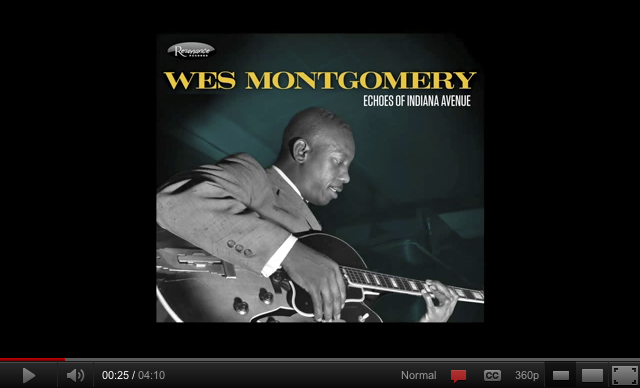
Wes Montgomery · Echoes of Indiana Avenue
Resonance Records HCD - 2011 · Release Date: March 6, 2012
For further information on this and other Resonance Records releases, visit: ResonanceRecords.org
Resonance Records is a program of the Rising Jazz Stars Foundation,
a 501(c)(3) non-profit corporation.
For media information, please contact:
DL Media · 610-667-0501
Jordy Freed · jordy@dlmediamusic.com
Don Lucoff · don@dlmediamusic.com